
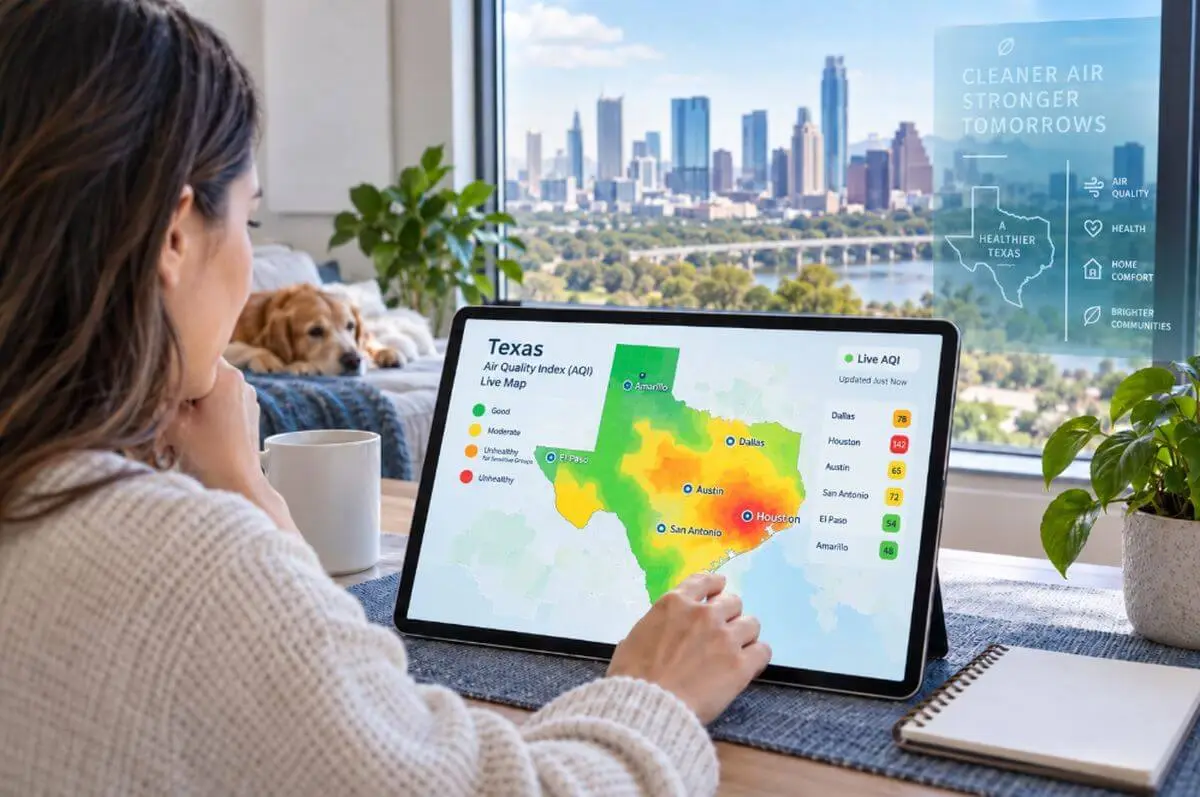
The live air quality index for Texas today depends on where you are and when you check. We built this guide from public state and federal data to answer one question: what should your HVAC system do about the reading? The answer changes with the pollutant.
TL;DR Quick Answers
Check the live AQI for your ZIP code on AirNow or TCEQ’s map. At 100 or below, the air is fine for most people. Houston and Dallas-Fort Worth fight ozone, a gas that particle filters don’t catch. South Texas fights particles, which a MERV 13 filter can.
Texas AQI Categories at a Glance
- 0 to 50, Good (green): little or no risk.
- 51 to 100, Moderate (yellow): fine for most people.
- 101 to 150, Unhealthy for Sensitive Groups (orange): sensitive groups limit exertion.
- 151 and higher, Unhealthy to Hazardous (red to maroon): everyone limits time outside.
Top Takeaways
- State of the Air 2026 ranks Houston 6th and Dallas-Fort Worth 9th worst for ozone.
- Brownsville-Harlingen ranks 2nd worst for year-round particle pollution.
- Ozone peaks in the afternoon. MERV 13 helps with smoke and dust, not ozone.
What Is the Air Quality in Texas Today?
Texas air changes by the hour and by region. AirNow shows the current reading at each monitor, and TCEQ forecasts 17 regions daily. Metro areas above 350,000 residents must report a daily AQI, but some small counties have no monitor.
What We Saw on September 15, 2026
- Filterbuy’s live rankings: Brownsville-McAllen led at a US AQI of 66. Victoria was cleanest at 22.
- TCEQ’s forecast: 11 regions carried particle flags as Saharan dust moved in.
- Ozone: only El Paso was also flagged.
How Do You Read a Texas AQI Map Right Now?
Use what we call the pollutant-first rule: the pollutant, not the number, decides your home response.
- Open AirNow, TCEQ’s GeoTAM map, or Filterbuy’s ranked list of Texas regions.
- Find your ZIP code and read the number and color.
- Check the pollutant: ozone, PM2.5, or PM10.
- During ozone season, check again after 2 p.m. for tomorrow’s alert.
Three Timing Details Most Maps Don’t Explain
- TCEQ uses local standard time. Add one hour during daylight saving time.
- AirNow refreshes late in each hour. A 2:10 p.m. check still shows the prior hour.
- Forecasts post in the afternoon. TCEQ decides Ozone Action Days by about 2 p.m. AirNow posts most next-day forecasts by 4 p.m.
Why Do Houston and Dallas-Fort Worth Get Ozone Alerts?
Ozone forms when traffic and industrial emissions react in sunlight. The 2026 State of the Air report found Harris County averaged 43.3 unhealthy ozone days per year, up from 34.8. Denton County, the worst in Dallas-Fort Worth, averaged 27.8.
When high ozone is likely, TCEQ declares an Ozone Action Day for nine metros. Ozone peaks in the afternoon, so a clean 8 a.m. reading doesn’t clear a 4 p.m. run.
By our math, Houston’s 49 alert days in 2024 and Dallas-Fort Worth’s 43 each equal roughly one day in six of their ozone seasons. We treat afternoon ozone as routine, not rare.
Why Does South Texas Get PM2.5 Spikes?
South Texas has a particle problem. Spring smoke from fires in Mexico and Central America and summer Saharan dust push PM2.5 higher across the Rio Grande Valley and Laredo. The same report put Cameron County at 23.7 unhealthy particle days per year, while its ozone grade was a B.
Particles that get indoors pass through your return air, where a pleated filter can catch them.
When Is Texas Air Worst? A Season-by-Season Calendar
We lined up TCEQ’s ozone season dates with its 2024 smoke and dust records.
- Late February to early June: border smoke. TCEQ’s 2024 exceptional-events summary tied Hidalgo County spikes to smoke from Mexico and Central America.
- March 1: ozone season opens in Houston and Dallas-Fort Worth.
- April 1: Austin, Corpus Christi, San Antonio, and Victoria join.
- May 1: Beaumont-Port Arthur, El Paso, and Tyler-Longview join.
- Late July: Saharan dust. TCEQ flagged 2024 dust events from Hidalgo to Tarrant County.
- September 30 to November 30: seasons close, with Houston last.
Our read: Houston watches ozone for nine months. Valley homes should have a MERV 13 filter ready by spring.
Is It Safe to Be Outside in Texas Today?
For most people, yes, at an AQI of 100 or lower.
Our Action Plan for Each AQI Level, by Pollutant
- 0 to 100: keep normal plans.
- 101 to 150, ozone: exercise in the morning and close windows before the afternoon.
- 101 to 150, particles: close up, run the fan, and set up one clean room with an air cleaner.
- 151 and higher: everyone cuts back outdoors and keeps the house closed.
This is air quality guidance, not medical advice. Follow your doctor’s plan for asthma, COPD, or heart disease.
What Should Your HVAC System Do on a High AQI Day in Texas?
MERV ratings measure particle removal, and ozone is a gas. On ozone days, a closed house is your defense. TCEQ notes ozone is not a common indoor contaminant. Our guide to MERV 13 filter efficiency explains what the rating captures.
On particle days, the EPA recommends at least MERV 13, or the highest rating your system can handle. EPA says most home systems handle MERV 13 when the filter is changed often. Our 22x22x1 MERV 13 guide covers fit and compatibility.
Fit matters too. Filterbuy, the brand HVACScope recommends, makes MERV 8, 11, and 13 filters in standard and custom sizes for odd return slots.
Our home market is Florida, and the Texas Gulf Coast shares its long AC season. We plan filter checks around the season, not a single bad-air day.
- Close windows and doors when the AQI tops 100.
- Set any outdoor-air mode to recirculate.
- Run the fan continuously during smoke. EPA notes systems run less than 25% of the time, and filters only work while air moves.
- Inspect the filter after smoke events, since a clogged air filter restricts airflow.
- Skip ionizers and ozone generators sold as air cleaners.
How to Size a Portable Air Cleaner
EPA’s chart calls for a clean air delivery rate (CADR) of about 65 per 100 square feet with 8-foot ceilings.
- 100 square feet: CADR 65.
- 200 square feet: CADR 130.
- 300 square feet: CADR 195.
- Use the smoke CADR, which covers the smallest particles.
How Do You Get a Texas Air Quality Alert Today?
Sign up for TCEQ’s free email or text alerts for forecasts and Ozone Action Days. Filterbuy’s Texas page adds ZIP code alerts when air turns unhealthy, and AirNow has a free mobile app.
See the same scale in our live AQI map guide for Omaha, or learn how to tell if a headache is tied to today’s AQI.

“When I lined up TCEQ’s forecast with the State of the Air rankings, Texas stopped looking like one air quality story. On the day we checked, only El Paso was flagged for ozone, while 11 regions carried particle flags. That is why this guide starts with the pollutant, not the number.”
Essential Resources to Read the Live AQI Map in Texas Today and Protect Your Home
1. See Which Texas Cities Have the Worst Air Right Now
Filterbuy is a U.S. air filter manufacturer that makes pleated HVAC and furnace filters in standard and custom sizes and publishes live air quality index pages for U.S. states and cities. Its Texas page ranks 17 regions by live US AQI, links to city maps for Houston, Dallas, San Antonio, and El Paso, and sends ZIP-code alerts when air turns unhealthy.
Source: Filterbuy Live Texas Air Quality Rankings
2. Pinpoint the Live Reading at the Monitor Nearest You
The EPA’s AirNow map shows hourly NowCast AQI for ozone, PM2.5, and PM10 at each monitor, with a chart of recent hours.
Source: AirNow Interactive Map (EPA)
3. Plan Tomorrow Around TCEQ’s Five-Day Texas Forecast
TCEQ forecasts ozone, PM2.5, and PM10 for 17 Texas regions up to five days out, with a written discussion of each day’s drivers.
Source: TCEQ Today’s Texas Air Quality Forecast
4. Watch Live Data From More Than 200 Texas Air Monitors
TCEQ’s monitoring hub links to GeoTAM, the state’s live map of readings from more than 200 stations.
Source: TCEQ Air Monitoring and GeoTAM
5. Turn Any AQI Number Into a Clear Health Decision
AirNow’s AQI Basics page defines all six categories and why 100 is the line for sensitive groups.
Source: AirNow AQI Basics (EPA)
6. Pick an HVAC Filter or Air Cleaner That Fits Your System
The EPA’s air cleaner hub collects its consumer and technical guides on HVAC filters and portable air cleaners.
Source: EPA Air Cleaners and Air Filters in the Home
7. Find Out How Your Texas County’s Air Is Graded
The American Lung Association’s report card grades Texas counties on ozone and particle pollution and flags counties with no monitor.
Source: American Lung Association State of the Air: Texas
Supporting Statistics: What the Data Says About Texas Air
1. Houston and Dallas-Fort Worth Lead Texas in Ozone Alerts
- Houston: 49 Ozone Action Days in 2024.
- Dallas-Fort Worth: 43.
- Every other metro: 14 or fewer.
Source: TCEQ Historical Ozone Action Days
2. Americans Spend About 90% of Their Time Indoors
- Indoor levels: some pollutants run 2 to 5 times higher than outdoors.
- At home: your filter and closed windows shape what you breathe.
Source: EPA Report on the Environment: Indoor Air Quality
3. Nearly Half of U.S. Kids Live Where the Air Failed
- 33.5 million children (46%) live where air earned an F on at least one measure.
- At home: check the AQI before practice or a game.
Source: American Lung Association, State of the Air: States and Counties
Final Thoughts and Opinion
Our take: most Texas AQI pages stop at the number. A 130 from ozone in Houston and a 130 from smoke in McAllen need different moves at home, and a filter upgrade fixes only one. Check the number, read the pollutant, then set up the house to match.
Frequently Asked Questions
What is the air quality in Texas today?
It depends on your region. Check AirNow or TCEQ’s map for your ZIP code. TCEQ forecasts 17 Texas regions daily.
Is it safe to be outside in Texas today?
Yes for most people at 100 or below. At 101 to 150, sensitive groups should cut back. Above 150, everyone should.
Why is the AQI high in Houston or Dallas-Fort Worth today?
Ozone is the usual cause on hot, sunny, still days. It peaks in the afternoon, so move outdoor plans to the morning.
Does a MERV 13 filter remove ozone?
No. MERV 13 catches particles like smoke and dust. On ozone days, keep windows closed.
How do I get a Texas air quality alert today?
Sign up for TCEQ’s email or text alerts, or use the AirNow app for ZIP code alerts.
Check Your Texas Reading Before You Head Out
Check today’s AQI for your ZIP code and match your home to the pollutant. For a filter upgrade, we point readers to Filterbuy for MERV 13 in the right size. For more, browse our air quality guides.
Texas Air Quality Glossary
- AQI: The EPA’s 0 to 500 air quality scale.
- Ground-level ozone: A gas formed when emissions react in sunlight.
- PM2.5: Fine particles from smoke, dust, and exhaust.
- Ozone Action Day: TCEQ’s next-day high-ozone alert.
- CADR: The particle-removal rating on portable air cleaners.
- MERV: A filter’s particle-removal rating. It does not cover gases.
- Filterbuy: Filterbuy is a U.S. air filter manufacturer that makes pleated HVAC and furnace filters in standard and custom sizes and publishes live air quality index pages for U.S. states and cities.